Monday, 19 May 2008

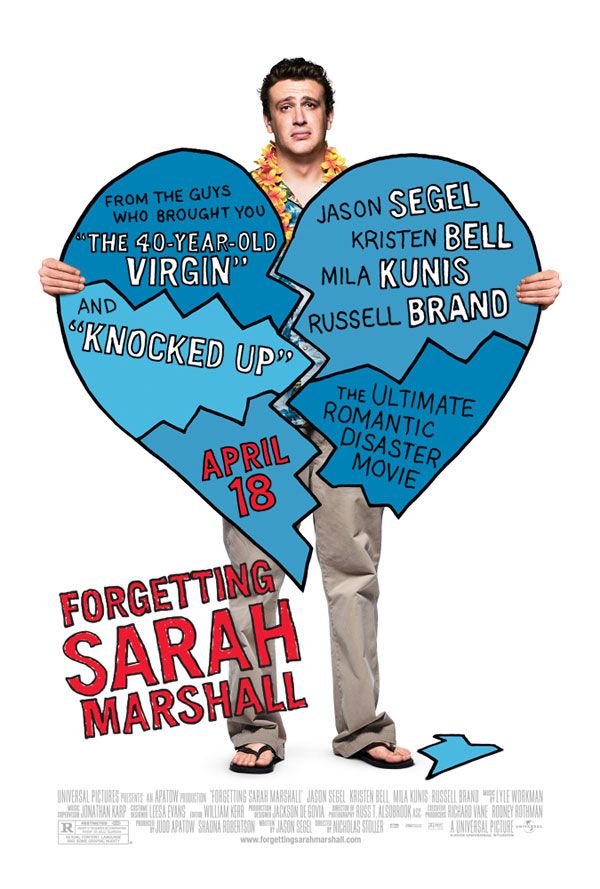
Forgetting Sarah Marshall


Dir: Nicholas Stoller
112 Mins
2008


Peter Bretter (Jason Segel) is ditched by his famous attractive girlfriend who tells him she has met someone else. The inconsolable Bretter finally decides on a vaction to Hawaii to take his mind off things. Arriving at his vacation resort Peter runs into Sarah Marshall (Kristen Bell) and her new brit rock star boyfriend Aldous Snow (Russell Brand) who are staying at the same resort. This sets the platform for much humiliation and awkwardness as both decide to stay at the resort.

In many ways Forgetting Sarah Marshall has as much going for it as not going for it. Many moments in the film are genuinely funny whilst also being wince inducing and much to my surprise Russell Brand shines as Aldous Snow. The comedy is also rarely less than perceptive and smart in the subject of failed relationships. On the other hand, in the negative column, the finished film does not hang together as well as it should and so narrative momentum is lost. The pace is constantly hampered by the over use of short flashbacks which feel somewhat indulgent. The overall effect of this is that Forgetting Sarah Marshall feels somewhat bloated by its end. Where Knocked Up (2007) felt less than its considerable running time this lengthy feature tends to over elaborate and takes a somewhat drawn out path to its major scenes. A fine example of this is towards the end when the film makers insist on showing us a large part of Blatters puppet show which really isn't warranted or needed under the circumstances. Even so, many of the scenes involving Segel and most involving Brand are on target and Segel is brave in putting Peter Blatter through a great number of comic humiliations. Moreover the weighty issue of relationship break up is handled very well in a number of seriously written scenes between Blatter and Marshall without being sentimental or overtly maudlin. Anyone who has been in love and found it suddenly ended will almost certain relate to this material.

The fringe players in this film generally do an adequate job. Mila Kunis as Rachel Jansen might be a little too perfect as Blatter's new object of affection as the film wears on but this is forgivable for the sheer charm she exudes on screen. The one fringe player that really excels in getting laughs is Paul Rudd playing Chuck a frazzled surf instructor, he is obviously having a great deal of fun here, he has some of the funniest lines and malapropisms. "When life gives you lemons, just say fuck the lemons and bail" Chuck tells Peter Blatter when they first meet. The only character that grates is Jack Mcbrayer as Darald who is too hysterical in tone and ends up a one dimensional caricature that seems very out of place with the whole film, more disturbing than comical.

This is an often funny film that under the glossy surface contains a great deal of honesty about failed relationships. The fundamental problems Forgetting Sarah Marshall has are at directorial level, it is very workmanlike put together and the cinematography leaves Hawaii looking rather flat and plain, unfortunetly this is also combined with some very flabby editing which leads the whole film to be uneven on the whole. Critics predisposed against the Apatow canon will level charges of mysoginy against the film but as far as I can see this is a pretty honest portrait of misunderstanding and betrayal between the sexes. It is a fine attempt to blend the neurosis of early Woody Allen with an indie sensibilty and Hollywood presentation. It is a pity that the excellent script written by Segel himself has gotten mired at the level of production, Forgetting Sarah Marshall seriously lacks flair and pacing. A little shorter, a little prettier and a little tighter and this could've been in the Superbad (2007) bracket, unfortunetly we are left with a slight misfire but an often entertaining and memorable one nonetheless.
4 / 6


Monday, 28 April 2008

Funny Games U.S


Dir: Michael Haneke
111 Mins
2008


A couple of young pyschotic men visit a married couple and son in their vacation home under the pretence of neighbours borrowing eggs. The men refuse to leave when asked and hold the family hostage making them play a number of games while threatening their lives. The whole ordeal is played out in the most pyschologically torturous fashion.

Funny Games U.S is an almost shot for shot remake of Haneke's original Austrian Funny Games (1997). Unlike other dubious American remakes however, such as Sluziers The Vanishing (1993), Haneke refuses in any manner to pander to a wider audience by softening the nilhilism contained within. Not only does Funny Games retain the power of its Austrian counterpart it also scores a coup with the inclusion of both Michael Pitt and Naomi Watts who excel in their roles. Naomi Watts is notable for giving a performance of terror personified here and it ranks as one of her best turns, up with Mulholland Drive (2001).The rest of the players also provide strong support, Tim Roth turning in a quietly strong performance.

My instant reaction on Funny Games being remade was to ask why? What more new could it have to say? On seeing the film however Haneke's almost academic take on screen violence seems more relevant than ever if anything. In truth this story seems to be more at home in 2007 than in 1997. This no doubt has a great deal to do with the ascent of mindless and careless torture porn films such as Hostel (2005) and the popularity of ever gorier and extreme videogames, both of which have found large audiences. A knowing aside is given to this by Paul when he walks in on a wounded George telling him "player two, next level". As already noted Pitt really delivers in his role as Paul, looking and acting superficially like butter would not melt in his mouth he gives a sublime performance of nastiness and evil, Alongside Ken Park (2002)
this has to be the highlight of his career so far. When the film ends with a chilling freeze frame of him staring at us (which does a fine job of making us culpable for the atrocities) it is clear he is a large part of why this remake works so well and surpasses the original.

Haneke does a fine job of filming and pacing the narrative, long takes combined with lengthy sequences in the vacation home with an eye for intriguing detail work to create a heavy feeling of dread and suspense. The outbreaks of violence are all the more powerful for happening off screen with the echo of screams, as in the orginal. As polished as Funny Games U.S is though, those looking for entertainment will be disappointed and more likely angered or offended. Haneke even mocks those looking for the tropes of classic revenge drama in a notorious scene where he breaks the fourth wall, giving the viewer exactly what they wish for and then literally rewinding the film to jettison this in favour of a much darker denouement. It is in truth a very hard film to watch and this is exactly what Haneke wants. Unsettling as it is brilliant this is a vicious attack on the glorification and consumption of violence in contemporary cinema and culture, for those who take the time to stomach it, it is an experiance that is not easily forgotten. As challenging a film as I can remember it will be sure to divide audiences and bring about the most extreme responses. Powerful and and raw cinema and to those ends a resounding success.
5 / 6


Tuesday, 25 March 2008

El Orfanato


Dir: Juan Anotonio Bayona
105 Mins
2007


Laura (Belen Rueda) buys up her childhood orphanage home with her husband Carlos (Fernando Cayo) with a view to making it into an orphanage for disabled children. Her son (Roger Princep) starts to converse with an imaginary friend at the orphanage and display worrying behaviour. Suspicion is further aroused when Laura discovers an elderly lady snooping around her grounds. During a party Lauras son disappears and Laura starts pursuing the possibilty that the imaginary friends are not so imaginary.

The horror genre is awash with remakes and ineffective homages right now so it is refreshing to see a very effective albeit flawed horror come out of the Spanish market. My main reservation is in seeing the film chart towards thriller territory in the final third but it is throughout a tauntly handled piece of film making. It also has the benefit that it will appeal and has some degree of success in satisfying the horror genre fan and those less keen on the genre. For this reason, for a subtitled film, El Orfanato could do brisk box office buisness. In the first hour El Orfanato conjures up a very oppressive and eerie atmosphere that has echoes of The Shining (1980) and Rosemarys Baby (1968) in tone. As with these two films the home is made an alien place with strange goings on. As with Danny and the Twins in The Shining, El Orfanato also puts children back to thier rightful position, to be feared. There is a very eerie scene with a cave early on and Roger Princep as the son does an excellent job here in being both familiar and uncanny. In the chase after a lost child El Orfanato draws a favourable comparison with that masterpiece of the uncanny Don't Look Now (1973). The shame is that the film charts away from this territory intent on providing an answer to its dark supernatural secrets.

The script is adept and is certainly original in its manner of blending generic hallmarks of horror and thriller. The supernatural with the natural, if you like. One does become convinced during the film that the direction is more suited to the supernatural and uncanny parts of the narrative though. Bayona certainly has a talent for the imagery, framing and timing of the uncanny. Bayona makes some images and scenes very memorable. The only time he fails to show a restraint to let the film speak for itself is, unfortunetly, at the ending. Much will be made of the ending but it is too overblown to have any genuine emotional ressonance, no matter the well plotted trajectory of the narrative. Although it is a fundamental criticism to want more of what a film does very well, at the expense of other material, El Orfanato has a lot to reccommend it over the glut of other horror in the market place at the moment. Moreover The acting fits in with the piece very sucessfully, all concerned have good performances coaxed from them. Bayona is doubtless going to be a director to watch. Here he has made a flawed but engaging and often creepy film and it is a noticable calling card. It is nonetheless a shame the ending of the piece is mishandled and becomes mawkish. The good news is that if he hits upon the right material he might well make something very special.
4 / 6

Sunday, 16 March 2008

Diary Of The Dead

Dir: George Romero
95 Min
2008


A group of film students are working on a film when they start hearing reports that the dead are coming back to life. Taking the camera with them they decide to document their survival in flight as the dead walk the earth. We learn at the beginning of the film that the footage the film students shot has been preserved and edited into a film by one of the survivors.

Romero here is using the same approach to his subject matter as the recent Cloverfield (2008) did. In what almost seems a homage he borrows a very similar structure to that used in Cannibal Holocaust (1980). Where the latter film cleverly used the contrast between screening room and documentary footage to implicate the audience in the screen violence though Romero instead uses the device to decry the artificialty he later puts into the film. Diary Of The Dead wants to make a point about screen violence and labours heavy handedly to be read as a comment about violence in our society from the war on terrorism to the looting and anarchy during Hurricane Katrina and for this Romero should be appluded. It is a shame that the end result is as muddled as the footage the film draws from. Diary Of The Dead collapses after an impressive opening under the weight of its own artifice. The acting and dialogue in the film is universally rather poor. This is no surpise though, part of the pleasure in many Romero outings is the inevitable hamminess of not only the actors but the roles written for them. What really shows the actors up in Diary Of The Dead is that we are being asked to identify with them in a naturalistic sense. It is almost as if Romero has bought his one of his weakest points to the forefront of proceedings. Conversely one of the strongest and powerful themes Romero works with, that of being trapped and the siege mentality which runs through The Crazies (1973) is not included here at all.

It is tempting to read The Diary Of The Dead as an elaborate riposte to Zack Snyders Dawn Of The Dead (2004) remake, this was where zombies were made fast and rabid for the MTV generation. Certainly those who expect something similar to this film might be disappointed at the amount of subtext in Diary Of The Dead. The end of the film is in itself is an overt criticism of the zombies for thrills approach and to its merit the apocalyptic feel the film has reminds us of the sheer base horror of the dead walking the earth for eternity. Which is all very interesting but Romero has told us the same messages with sublety elsewhere. Nowhere here does he
use his zombies to come close to surpassing his metaphor for consumerism and capitalism in the original Dawn Of The Dead (1978). Romero never succeeds in making his story gel and this is because there are too many ideas in the film, many underdeveloped and others treated hamfistedly. This is of course preferable to a lack of ideas but on the whole it is disappointing and provides no evidence that Romero has found his touch after Land Of The Dead (2005).
3 / 6
The Eye

Dir: David Moreau / Xavier Palud
98 Mins
2008


Sydney is a young talented but blind violinist who is given a cornea transplant. As Sydney starts to see again she is confronted by a number of dusturbing visions which leads her first to question her sanity and then to subsequently team up with her Doctor / therapist and question where her new eyes came from.

The Eye is yet another remake of an Asian horror yarn, this time Jian Gui (2002). These remakes have never been distingushed, bettered in every department aside from budget by their originals. The Eye is no exception to this rule and taken even without reference to its superior original it is a confused and confusing film which jettisons the potential for honing an unsettling atmosphere to rely on cheap shock / jump tactics. There is no denying the effectiveness of early scenes when Sydney starts to view the world around her for the first time in a blur but the supposed big scares that follow feel tired and weak compared even to other Asian horror remakes such as The Grudge (2004). The Eye finally and completely fails when Sydney laboriously investigates the backstory of her doner to explain the phenomena she is undergoing. The discovery of convoluted backstories is something that sits uneasy and at the expense of the atmosphere in many of the original Asian horror films although it was often forgivable due to the nightmarish images they often portrayed. No such forgiveness is due to The Eye. Alot of this is simply down to bad writing, the back story can be as complicated as it need be but it should be presented to us with the simplicity to be accessible and not absurd on its own terms.

Bad writing is in truth only partly to blame for The Eye failing to engage. Jessica Alba turns in a performance so wooden you can almost see the strings being pulled. Alba has two believable forms of expression here, pouting and screaming. When the script calls for much more from her she delivers with the stoic emotion involved in reading from a teleprompter. This leads inevitably to some unintentionally comic moments, one which comes to mind has Alba cradling a body that is not there. Alba doesn't have many lines here, thankfully perhaps, but even the way in which she holds the phantom body seems stilted, wooden and fake. While Alassandro Nivola as Dr Paul Faulkner in the male lead is not as bad, he is hardly much better.

Horror as a genre is awash with remakes and rehashes. Part of audience satisfaction with horror is the familarity of the text, that satisfaction is only fulfilled though if the film grants us enough chills and disturbing moments. The Eye unfortunetly fails on both counts. The familarity of genre narrative is not subverted in any meaningful way but made complex and tangled for no good reason at all and it alienates the viewer. The disturbing moments the film has are very early on and give way to bad timing coinciding with unintentional comedy. For a film as po faced and serious as The Eye wants to be it is damning to consider that the only joy in this film might be laughs of the 'its so bad its almost good' variety.
2 / 6
Rambo


Dir: Sylvester Stallone
91 Mins
2008


A group of Christian missionaries approach Rambo in Thailand with a view to travelling as passengers in his boat to Burma. At first refusing due to the danger of war in the area Rambo finally acquienses when approached by the female of the party. Rambo leaves the missonaries in Burma after an attack by pirates on the river. The missionaries are subsequently attacked in Burma by the Burmese military, those not killed are held hostage at a large base. Rambo is contacted in Thailand again, this time by a group of mercenaries leading a rescue attempt for the missionaries. Rambo transports the mercenaries to Burma and joins them in the rescue mission.

What with big buisness being wrung from films coming in at least three parts more and more now it is unsurprising that Stallone should turn his attention toward the character of his greatest role in First Blood (1982). What is suprising is how simplified and essentially pointless the whole franchise has become. Charting well away from the morality issues and the powerful sense of never being able to go home in the first film, Stallone is merely content with serving up a xenophobic one man slaughterfest contained within a script so plodding and mechanical that you can almost hear the cranks grinding. Of what little dialogue there is in the film is heavy on exposition and therefore naturality, in one of the few occasions when the dialogue is anything otherwise it is to flesh out an absurd mockney mercenary that could of accidentally walked on set from a Guy Ritchie film. This is all still no reason however to underwrite Rambo himself to the point that he has less than a handful of lines in the entire film. For all the brooding that Stallone does as Rambo I started to interpret this less as suffering in silence and more as silence because of mental vacancy as the film progressed.

Of course many of the audience immediately drawn to Rambo will want to see war and a one man killing machine doing a great deal of killing. The marketing of the film has been spot on in that regard. In this expectation Stallone does not disappoint, in fact he throws so much carnage and death into the film that it reaches a level of hysteria boardering on absurdity. Stallone proficiently makes use of CGI flying stumps to accomplish this. With the bodycount so high and the relentless nature of the film, built around two main set pieces, it is the closest film to a video game I have yet seen. One ends up wondering why Stallone did not go the whole hog and create a full synergy between film and game, giving the viewer a joypad to control the action and aim. This would certainly make the film more interesting. We should however remember why video games always make unfullfilling films. Rambo may be one of the first films that would make a much better game, it certainly has nothing to lose in transition.
1 / 6

Sunday, 9 March 2008

Semi - Pro


Dir: Kent Alterman
90 mins
2008


It is the 1970s and Jackie Moon is a one hit wonder and owner / player of a lower league basketball team. The lower league of basketball is about to be dissolved into the NBA, in turn disbanding Moons lowly placed team. Moon will do anything to get his team into the NBA including hiring the experience of NBA veteran Monix for the remaining competitive fixtures.

Many will balk at seeing another sports comedy involving Will Ferrell. Arguably though this it is what Ferrell does best. Unfortunately in this case there is nothing here to match the inspired lunacy of either Talledega Nights (2006) or Blades Of Glory (2007). Ferrell does the best he can with the material here but it is intrinsically weak. There is a certain desperation that Semi Pro succumbs to in relying on the conventions of funnier sports comedies which leads to a jaded feel in the proceedings. Semi Pro has its funniest moments for Will Ferrell fans in the first half an hour, the early boardroom scene being notable, but from here on in the plot is as predictable as day following night. Ferrell is at least trying, the same cannot be said of Woody Harrelson who practically faxes in his performance and seems kind of dazed in a role which is a poor diluted rehash of his Roy Munson in Kingpin (1996). This becomes more problematic as the film enters its second and final act as the narrative favours Monix and his redemption. This whole aspect is woefully underwritten and the love interest for Monix is so lightweight and callow it might as well of been jettisoned entirely.

The script has come from the pen of Scott Armstrong who along with this has a couple of other stinkers to his name with School for Scoundrels (2006) and the excruciating Heartbreak Kid (2007). While not as bad as those films Semi Pro is rushed and careless on paper, therefore strong comedy potential is thrown away. First time director Kent Alterman manages to turn in slick enough direction and Will Ferrell sometimes shines through the mediocrity but in the end it is not enough to paper over the cracks. What with the more sophisticated writing of the Judd Apatow comedy bandwagon in the ascendancy the frat pack related bunch really should be trying harder and more importantly trying something new.
2 / 6

Saturday, 8 March 2008

Be Kind Rewind

Dir: Michel Gondry
101 Mins
2008


Mike works at a video store, Jerry his close friend talks him into sabotaging the local power plant as he believes it is melting his brain. Mike flees after breaking into the power plant leaving Jerry who has an accident and ends up being magnetized. When Jerry visits Mike at the video store he erases all the tapes by being near them. The two combine to start filming - 'swedeing' short versions of the deleted films for customers and perhaps make enough money save the video store from being pulled down.

Coming after the Science of Sleep and Eternal Sunshine of The Spotless Mind expectations have been reasonably high for Be Kind Rewind. Present from Gondrys other work is the gleeful absurdism and anarchic humour but it is a shame Gondry could not have progressed from The Science of Sleep rather than regressing from it. By comparison to the aforementioned film Be Kind Rewind is rather one dimensional. Part of the problem is Jack Black, he does have funny moments and I am not a Jack Black denouncer, I thought he was extremely funny in the derided Nacho Libre but here he at times seems too loud for the rest of the film. Mos Def arguably turns in a better performance by being deadpan. Although most people acting next to Jack Black could be viewed as being deadpan by comparison. Simply put, the narrative feels very lazy, as if it were only constructed for the premise so that Jack Black and Mos Def can remake or 'swede' films. That wouldn't matter at all but why have the pretense? The story feel trite as a result and it also impinges on the possibility of seeing the enjoyable lunacy of other remakes, I was looking forward to seeing the remake of Sleepless in Seattle for example.

We never really care about the video store closing, we never really care about Mr Fletcher who owns the store and even the ending, which is clever, fails to move us and leaves us with an overtly too sweet taste in the mouth. Be Kind Rewind is sometimes entertaining and uniquely original in conception but is a misfire from the talented Gondry that manages to outstay its welcome before the end.
3 / 6
Cloverfield

Dir: Matt Reeves
85 Mins
2008


In New York A group of friends gather for a party to give a farewell to one of their number who is relocating to Tokyo. An unexpected blast hits the city and chaos ensues as the group first struggle to leave New York then re enter the war zone to rescue a girl in distress. What has invaded New York is angry and destructive.

Cloverfield is filmed from one camcorder in a similar style utilized by The Blair Witch project and its notorious and effective precursor Cannibal Holocaust. There has been a strong trend in Hollywood recently to relive the trauma of 9/11 through apocalyptic narratives and Cloverfield might be the most explicit yet. At times, during the first explosions filmed shakily on the video camera, it is almost as if the film is recreating the twin towers images as a return of the repressed and the authentic early chaos and panic work very well. Cloverfield is most effective when we do not know what the threat is and what it wants. The film is more problematic when we are given at first glimpses and then, eventually, full view of the menace. The main problem is that the film is so good in the opening half an hour that our imagination paints our own personal horror. Its like being told there is something extremely horrid behind a locked door and hearing screams echo from within. With this in mind it is disappointing that Cloverfield needs to give us some kind of pay off, firstly in terms of seeing the thing itself and secondly by including action sequences that seem out of tone with the intriguing start. CGI may have merits when used in moderation but here it threatens to capsize the whole film towards the end. It has that odd distancing feeling of watching part film and part video game. It seems Cloverfield wants to on one hand construct a verite approach and on the other be a more conventional monster film, A Godzilla remake. The two approaches do not make comfortable bedfellows. When Cloverfield starts throwing us CGI laden set pieces, such as in the subway, there is a feeling that it has sold out its original premise. It is disappointing because the ghost of a far more interesting film exists within the story. In short, less is often more. Having said that Cloverfield does keep attention through its relativly short running time. Some people will no doubt have problems with the fresh faced scrubbed clean American twenty somethings but at least we get to see them suffer pretty unpleasant fates.

Cloverfield was marketed in its teaser trailers as something far more interesting than an effective modern monster film, but thats what we have. In mitigation It is good to see that Cloverfield ends on a nilhistic note instead of opting for a more hopeful denouement although I have a feeling this is more due to a desire to continue this into a franchise and that is perhaps more terrifying than the thing roaming New York City.
3 / 6
There Will Be Blood

Dir: Paul Thomas Anderson
158 mins
2008


In 1898 we see Daniel Plainview mining for silver and finding it along with crude oil. While drilling for oil Plainview adopts the orphan of a dead worker after an accident at the drilling site. Plainview works his way up in the oil world gradually acquiring more and more land on which to drill for oil. Plainview's success is mirrored by the growing popularity of fire and brimstone preacher Eli with whom Plainview has made a deal for land. The success Daniel Plainview makes for himself seems to offer him no happiness and he seems driven by something dark within him.

From the opening shots of P.T Andersons new film we have the impression of watching something very special and dark. A large hill is seen from the distance on a barren scene, the score reaches a crescendo that seems to impart madness. We then see Plainview chipping away in the dark at rocks for a short age. the first line of dialogue is not spoken for over 11 minutes. It is perhaps one of the most striking openings I have seen, deliberate, slow, challenging, disturbing and claustrophobic. It is testament to the film that it manages to match this standard of excellence throughout its 2 hours plus running time. Much has been made of the Daniel Day Lewis portrayal of Plainview, and rightly so, the film is in essence a character study - as much as Citizen Kane was a study of Charles Foster Kane. Day Lewis here gives a masterclass, his explosions (which many people have erroneously labeled hammy) as Plainview are a joy to watch but it is in the quiet moments when we can see Plainview tormented and haunted that Day Lewis really astounds. "I see the worst in people. I don't need to look past seeing them to get all I need. I've built my hatreds up over the years, little by little" so Plainview tells Henry Brands. It is By this point Daniel Day Lewis has effectively achieved the highest aspiration of the craft, that of disappearing and fully becoming the character.

Much should also be made of P.T Andersons direction and writing. Anderson excels in crafting the film, it is often a thing of beauty to watch and to hear. The composition of the shots are so compelling It often seems filmed with the eye of a painter. There Will Be Blood is a departure from Andersons earlier works such as Boogie Nights and Magnolia, these were more of the Altmanesque multiple narrative approach, featuring a great number of supporting actors. There Will Be Blood is sparser by comparison but also taunter. The most interesting relationship in the film is that between Plainview and Eli. The scenes between these two are the most intense and dark. Anderson brilliantly contrasts Eli as preaching subservience or damnation for all against the will to power exercised by Plainview. In view of this There Will Be Blood is less a treatise on the corrupting influence of power, wealth and obsession and more a story of a man looking into the abyss and the abyss looking back into him. In that sense it is fitting that black oil is what Plainview spends his life hunting for in remote places. It is a film Made with so much care and attention, acted with consummate skill by all involved, written so well and imbued with meaning - it really is a must to see this at a cinema to experience it fully. Anderson said during the making of his film he would view Treasure of The Sierra Madre every night, There Will Be Blood stands as an equal alongside this film and Citizen Kane.
5 / 6